Love Potion at Hogwarts
Much of the conversation around artificial intelligence (AI) seems to revolve around productivity and controversy. We talk about using AI to work faster, research more efficiently, automate repetitive tasks, analyze information, write code, and generally accomplish more in less time.
At the same time, there are ongoing debates surrounding copyright, intellectual property, training data, creative work, and what all of this means for the future. Those are important conversations, and AI is a useful tool that I use for many things.
Sometimes, though, it is fun to use an incredibly sophisticated piece of technology simply because you have an idea you want to explore, while learning a little more about what you can do with it along the way.
This is how Sally and I ended up kissing at Hogwarts.
Sally and I have been together since 2016. She is my Sweet Sally, my sweetness. When we first met, one of the things we quickly discovered we had in common was a love of all things Harry Potter. We had both read the books and seen the movies, and we loved the larger fictional world surrounding them.
Over the years, Harry Potter became part of our life together. We attended several festivals, including the Harry Potter Festival that used to take over Chestnut Hill, Pennsylvania, each October. The festival is gone now, but those visits remain among our fondest memories.
Don't even get me started on the Platform 9¾ boxers one of the Chestnut Hill shops sold during the festival.
We even attended the festival in our own simple cosplay costumes. Nothing elaborate or particularly authentic, just enough to join in the fun and spend an afternoon pretending we belonged in that world.
Of course, we also knew what houses we belonged to at Hogwarts. Years ago, Sally and I both took part in the Sorting Ceremony on what was then Pottermore.com. I was sorted into Ravenclaw, while Sally was naturally, and rather quickly, sorted into Slytherin. I suppose we are evidence that an inter-house relationship can work.
Ravenclaw Returns to Hogwarts
I have been using some of my recent experiments with image generation in ChatGPT to explore techniques I may use in future fictional projects. I have been particularly interested in how well ChatGPT can use multiple photographs as visual references to create entirely new scenes.
I chose ChatGPT for these experiments because I have found it more consistent when working with reference photographs. There tends to be less drift from the supplied images, and it also handles text within an image better. I still prefer Midjourney when creating an original image entirely from a prompt, but when reference images matter, ChatGPT has become my preferred tool.
For this experiment, I decided to focus on environmental portraiture and see how convincingly I could place myself somewhere I had never been. Or, in this case, somewhere I couldn't possibly have been.
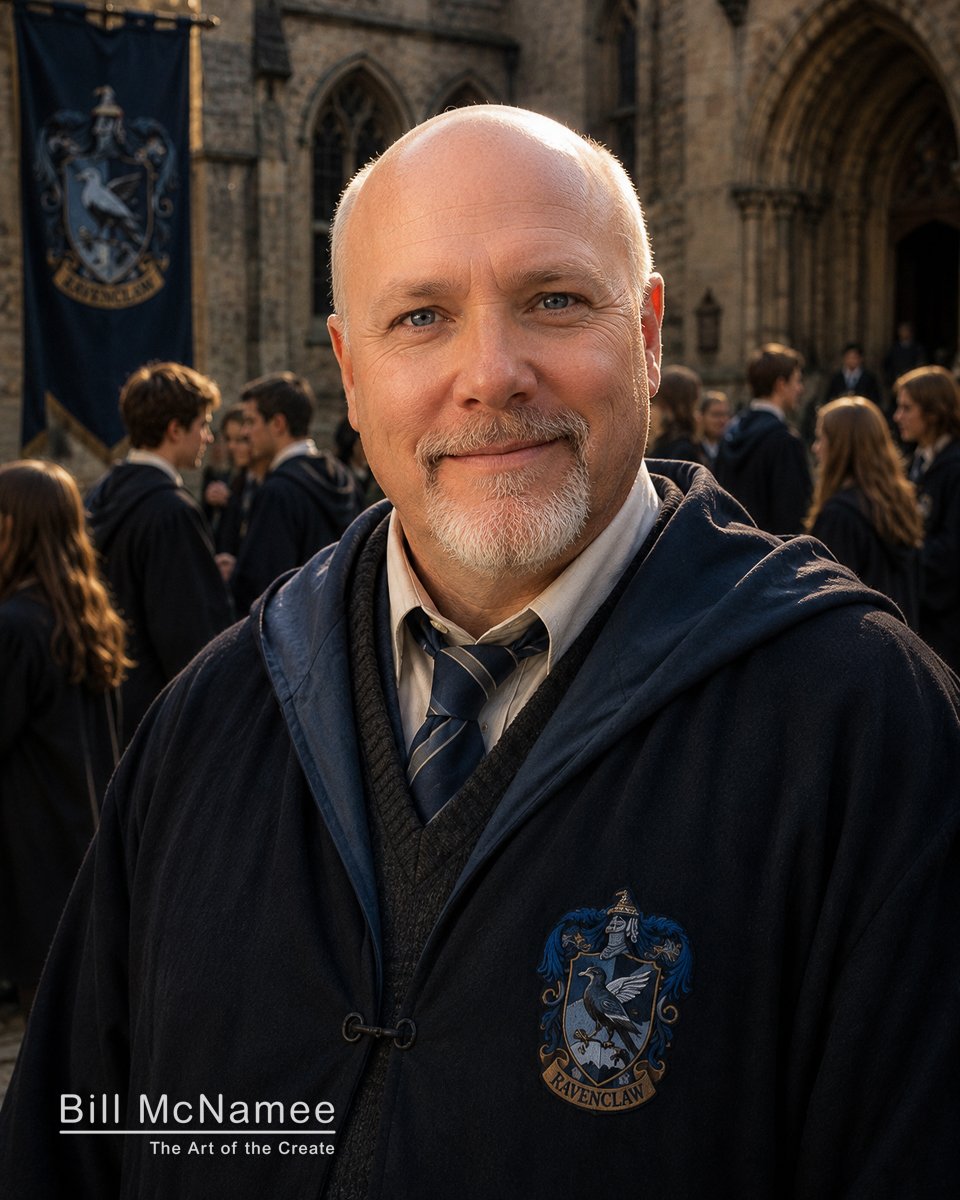
At some point during these experiments, my Harry Potter connection gave me an idea. What would I look like as a Ravenclaw at Hogwarts?
I selected twelve photographs of myself to use as references. Some were relatively recent, while others were older. They showed me at different angles, in different lighting, with different expressions and poses. The idea was to give ChatGPT enough visual information to understand what I look like rather than asking it to reproduce the appearance contained in a single photograph.
From there, I began describing the photograph I wanted to create. I wanted a realistic environmental portrait on the grounds of Hogwarts, with me dressed appropriately as a Ravenclaw. There should be other Hogwarts students in the background, dressed for their respective houses, but the finished image needed to look like a photograph rather than an illustration, movie poster, or piece of fantasy artwork. This was the basic prompt.
It sounded fairly straightforward. It wasn't.
As the image developed, the photographer in me started taking over. I found myself tweaking lighting, pose, expression, depth of field, background activity, clothing, composition, and all the other fine details that make a photograph more than a snapshot. I was no longer simply asking ChatGPT to put me at Hogwarts. I was refining a prompt and directing a portrait session that could never actually take place.
There was also the matter of my head. For reasons known only to ChatGPT, it became convinced that a friendly environmental portrait required me to tilt my head. I disagreed. We went back and forth about this more times than should have been necessary before finally arriving at an image where Ravenclaw Bill was standing at Hogwarts with his head "reasonably" upright.
I loved the result. Naturally, I wanted to do it again.
Enter the Slytherin
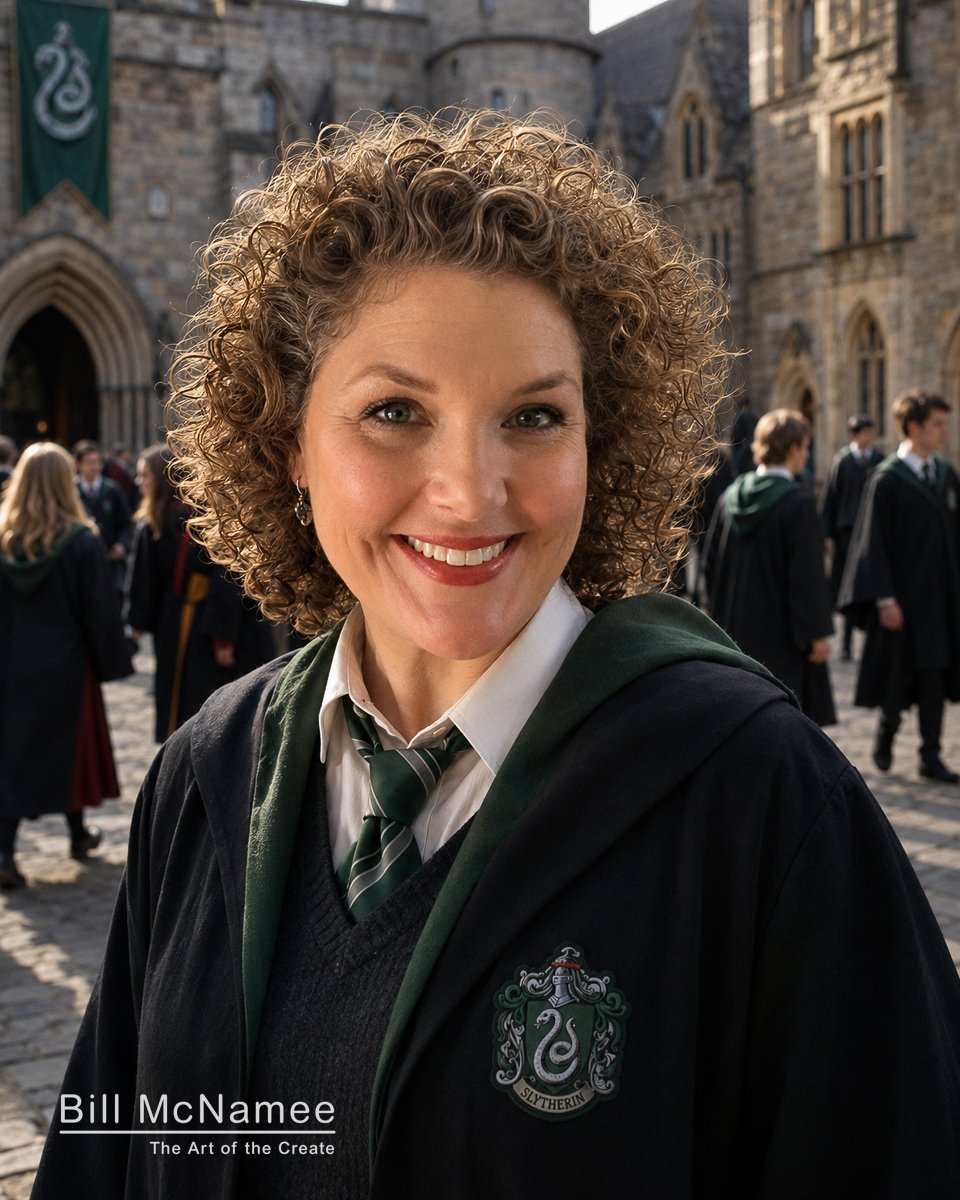
For Sally's portrait, I followed essentially the same process. I selected twelve photographs of her, again using a combination of older and more recent images with different expressions, angles, poses, and lighting.
This time, I could build upon everything I had learned while creating my own portrait. The prompt became more specific about facial likeness, pose, lighting, clothing, photographic realism, and even head position. I was learning how to communicate what I wanted, but I was also learning that creating a successful AI image could involve considerably more direction than simply typing a clever prompt and pressing a button.
Eventually, there was Sally standing on the grounds of Hogwarts dressed as a Slytherin.
Seeing the two finished portraits together changed the experiment. They worked individually, but they also looked as though they belonged to the same fictional world. Ravenclaw Bill existed. Slytherin Sally existed. The obvious question became whether I could put them together.
I already knew what photograph I wanted.
Kissio Maxima!
For the third image, the kiss, I changed the process. Instead of going back to the original twenty-four photographs, I used the two finished Hogwarts portraits as the references. Those images had already established our appearances within the fictional environment, including our clothing and our Hogwarts houses.
To create this scene, I gave ChatGPT several real photographs of Sally and me kissing to use as additional references. The idea wasn't to recreate any one of those photographs. Instead, I wanted them to show ChatGPT how we naturally come together for a kiss, while the two Hogwarts portraits established how we should look in the finished image.
The resulting image is a composite recreation of something real in a place that is completely imaginary. Sally and I are real. Our relationship is real. The kiss is based upon real photographs and real kisses between the two of us. Our appearances were built from real photographs spanning different periods of our lives.
This moment at Hogwarts never took place. Yet there we were, Ravenclaw and Slytherin, kissing on the grounds of the school.
In many ways, this was our return to cosplay. Sally and I had done the physical version years earlier in Chestnut Hill. We dressed up, walked through a town temporarily transformed by thousands of Harry Potter fans, and played along with the fantasy for a weekend. This time we did much the same thing using photographs, imagination, and Generative AI. Digital cosplay.
Muggles Playing With Magic
There are plenty of serious conversations taking place around Generative AI. Copyright, intellectual property, training data, disclosure, responsible use, and the future of creative work are all legitimate subjects worth discussing.
This is not a story about any of these.
These images are something I created for Sally and me. I am not claiming we visited Hogwarts, and I am certainly not claiming any ownership of that fictional world. They simply gave us another way to step into a world we have enjoyed together for years.
It is fun. It is creative. It is a fan-based expression of our love for the stories that created that world.
I use technology throughout my creative life. It is part of my workflow for photography, writing, and publishing. Much of the time, I use it because I am trying to accomplish something I could not do on my own or automate tasks to be more productive. Generative AI, along with Assistive AI, has become another tool within my larger creative environment.
But not every creative endeavor needs a practical purpose, a productivity benefit, or a business case. Sometimes creativity begins with nothing more than wondering what something might look like and having the tools available to find out.
Years after Sally and I discovered that we shared a love of Harry Potter, I got to see my Sweet Sally as a Slytherin. She got her Ravenclaw. And, for at least one photograph, we got to visit Hogwarts together.
___
Technical Notes:
The images in this post were created using Generative AI in ChatGPT, using real photographs of Bill and Sally as visual references. Minor artifact corrections and final image preparation, including applying a slight vignette and some film grain, were completed in Adobe Lightroom. The images were also processed at a larger working resolution before being reduced to their final output size, a technique I use to create crisp detail without excessive sharpening. All finished images are presented in either a 4:5 or a 3:2 aspect ratio.
This is an independent fan project and is not affiliated with or endorsed by the owners of the Harry Potter or Wizarding World properties.